What is radon gas? Is it dangerous?
Is radon really bad for you?
Breathing radon over time increases your risk of lung cancer. Radon is the second leading cause of lung cancer in the United States. Nationally, the EPA estimates that about 21,000 people die each year from radon-related lung cancer. Only smoking causes more lung cancer deaths.
The incident dramatized the truth that radon degrees in particular homes can occasionally be orders of size greater than common. Radon quickly ended up being a conventional home owner issue, though typical domestic direct exposures are a couple of orders of magnitude lower (100 Bq/m3, or 2.5 pCi/L), making individual testing necessary to assessment of radon risk in any kind of particular dwelling. Radon doesn't cause scratchy eyes or sprinkling noses, however it does damage your lungs gradually. Long-term direct exposure over the course of years, even if radon degrees drop and also increase in time, considerably increases your opportunities of establishing lung cancer. Considering that you're investing hrs at a time in your house inhaling the air, you're mosting likely to take in lots of radon as you prepare, bathe, and rest if it's present in the house's air supply.
Researchers concentrated on 2,500 Finns who had actually resided in the exact same residences-- having low to high interior radon levels-- for two decades; they took care to change for cigarette smoking. " Our results do not suggest increased threat of lung cancer from indoor radon." The study implies that interior radon exposure does not seem an important reason for lung cancer cells. Radon is RADON1.Com a contaminated gas emitted naturally from the ground.
Is radon mitigation really necessary?
When radon gas enters the body, it exposes the lungs to small amounts of radiation. In small quantities, experts say this is harmless. However, in persistent exposures or larger quantities, radon can damage the cells of the lining of the lungs, increasing a person's chance of developing lung cancer.
It can also be released from constructing products or through water stemming from radon-contaminated wells, according to the National Institutes of Wellness (NIH). Radon degrees can be higher in houses as well as buildings that are well-insulated, firmly secured or built on dirt rich in the contaminated elements uranium, radium and thorium.
- Your threat of lung cancer cells increases considerably with direct exposure to greater radon levels.
- Radon gas is a naturally-occurring byproduct of the contaminated degeneration of Uranium in the dirt.
- Depending upon your geographical place, the radon levels of the air you breathe beyond your home might be as high as 0.75 pCi/L.
- The US EPA has placed it plainly, specifying, "Any type of radon exposure has some threat of triggering lung cancer.
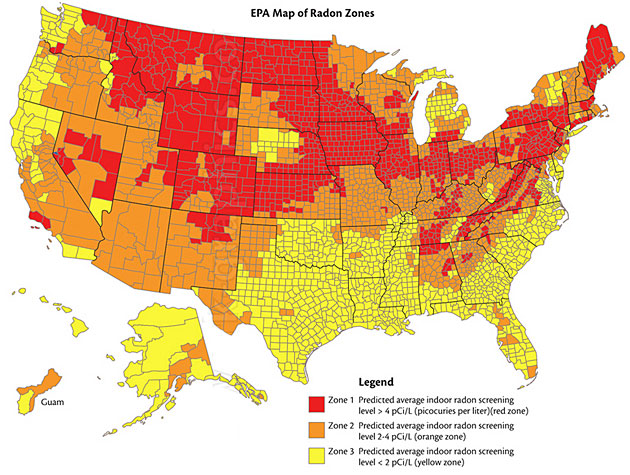
If a resident's long-lasting direct exposure will certainly average 4 picocuries per litre (pCi/L) that is 148 Bq/m3, the United States Environmental Security Agency (EPA) recommends residences be repaired. The United States Specialist General and also the EPA both recommend that all houses be checked for radon. Many states have active radon screening as well as reduction programs in place, which call for testing in structures such as public schools. Nevertheless, these are not standard nationwide, as well as the rules as well as regulations on minimizing high radon degrees are even much less usual.
Health and wellness
Thinking you live in an area not impacted by radon is simply one of the myths about this harmful gas. We evaluated all material pertaining to radon on state federal government Website utilizing a standard data collection kind.
How long does it take for radon to cause cancer?
Fact: You will reduce your risk of lung cancer when you reduce radon levels, even if you've lived with an elevated radon level for a long time. Keep in mind that radon levels below 4 pCi/L still pose some risk and that radon levels can be reduced to 2 pCi/L or below in most homes.